
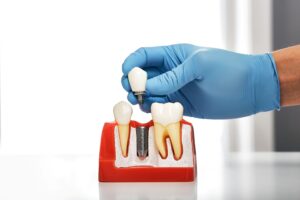
Many experts consider dental implants the ideal way to rebuild smiles after tooth loss because of their unique advantages. Unlike dentures and bridges, these restorations are placed directly in your jaw, which usually makes them stronger and longer-lasting than the alternatives.
This has led some patients to wonder whether these resilient replacements are stronger than natural teeth, and whether they can replace still-viable teeth in their mouths. Continue reading to learn more about it to understand why it’s usually not recommended!
How Do Dental Implants Work?
These prosthetics are often more resilient than other solutions for tooth loss because they’re surgically embedded in the jawbone. It can take several months to recover from this procedure, as your mouth must produce enough new bone growth to fuse with the supports placed there, making them a more permanent part of your mouth.
Once you’ve healed sufficiently, your dentist can make impressions to design a one-of-a-kind restoration, such as a dental crown, bridge, or dentures, that anchor to your implant(s) to close the gap(s) in your grin left behind by one or more missing teeth.
Are Dental Implants Stronger Than Teeth?
Dental implants are made from biocompatible materials, such as titanium or zirconia, that can last 20+ years when cared for correctly and are strong enough to withstand the pressure of daily biting and chewing. But that doesn’t necessarily mean they’re stronger than the teeth you were born with.
In most cases, it’s best to protect and preserve your natural teeth because it’s better for your oral health. For example, the roots stimulate new bone growth in the jaw each time you bite down to help keep it active and healthy. When one is lost, you can lose up to 20% of the surrounding bone density within the first year alone. Dental implants are the only replacements that fulfill this function, but they might only restore up to 80% of your original chewing power.
As a result, most dentists prioritize treating, repairing, or restoring your natural teeth over extracting or replacing them with dental implants, which is often only considered as a last resort when no other treatments can effectively mend overly decayed or damaged enamel.
Should I Replace Viable Teeth With Implants?
Most professionals don’t recommend removing still-healthy teeth to replace them with dental implants, but there may be exceptions, such as if the tooth is already severely broken, infected, or poses some other risk to your dental health. Only your dentist can determine for sure whether you require this or other treatments based on your current condition.
If you have questions about your oral health or whether you require services to improve it, the best next step is to schedule an appointment with your provider!
About the Practice
Patients at Dental Associates of Delaware benefit from a team of dental experts who are passionate about helping them build and maintain the healthiest, most beautiful versions of their smiles. They collaborate across six offices throughout the state to provide a comprehensive menu of services, including implant placement and restoration, so it’s easier to make an appointment close to home. You can request an appointment on the website or by calling one of their conveniently located offices near you!